
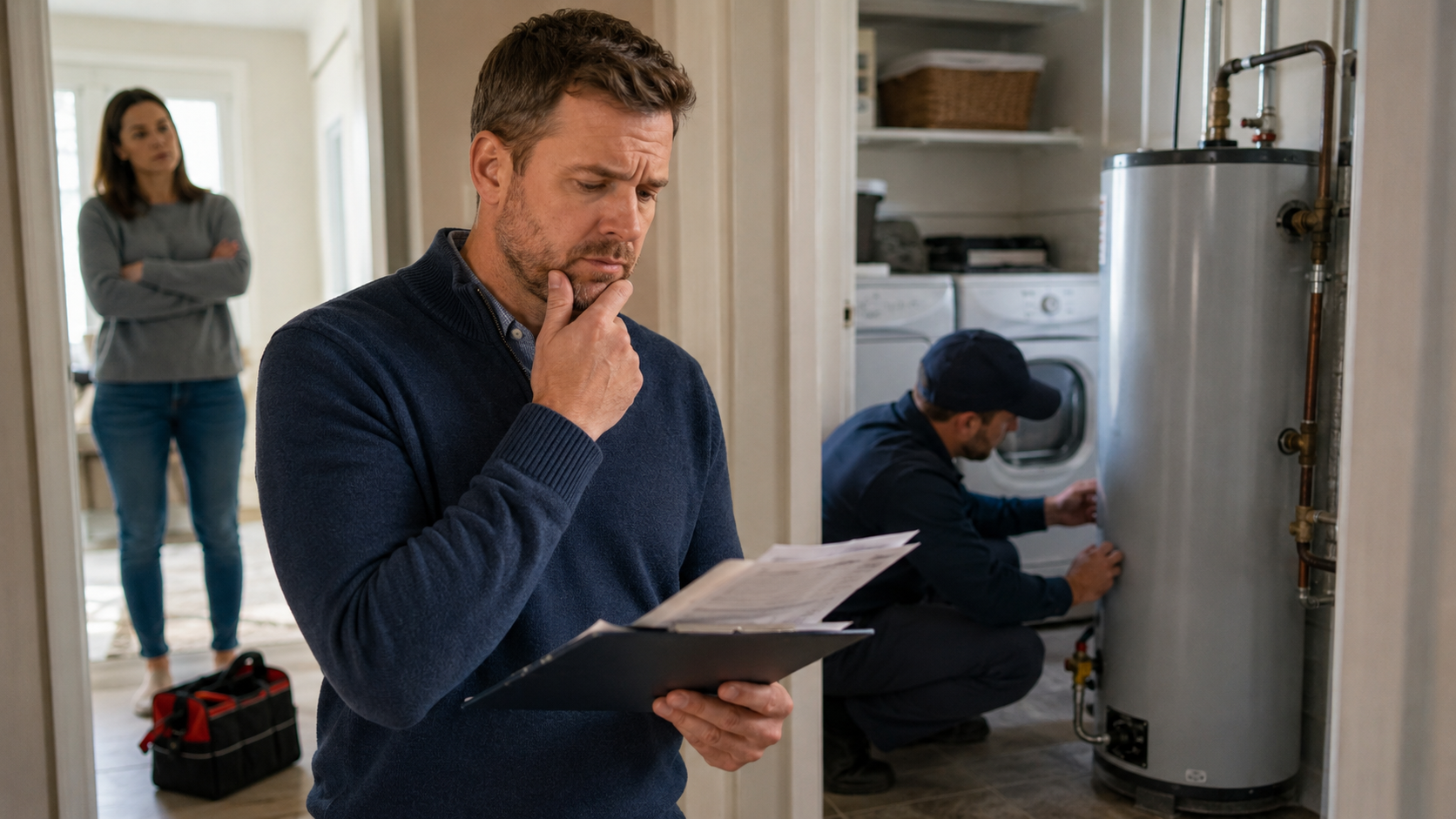
For many first-time landlords, a home warranty sounds like a smart way to control repair costs. After all, if a water heater, air conditioner, refrigerator, or appliance breaks down, the warranty company may send a vendor and help cover part of the repair.
That may work well for a homeowner living in their own property. But for a rental property, the priorities are different.
When you are a landlord, the issue is not just whether a repair is covered. The bigger questions are:
- Can the repair be completed quickly?
- Will the tenant be kept comfortable and informed?
- Will the delay create habitability concerns?
- Will the owner save money, or lose more through rent credits, tenant complaints, and legal exposure?
A recent internal case study involving a broken water heater shows why home warranties can become a problem for landlords, especially when the repair affects an essential service like hot water.
The Situation: A Tenant Reported a Leaking Water Heater
A tenant reported that the water heater was leaking and no longer providing hot water. Our team contacted the property owner the same day to ask whether the water heater was still under the manufacturer’s warranty.
The owner confirmed that the water heater was no longer under the original warranty but said they had a home warranty policy. At the same time, our regular vendor was dispatched to diagnose the problem and address the active leak.
Our vendor was able to take care of the leak and recommended either replacing the water heater for approximately $1,550 or replacing the burner and gas valve for approximately $800.
Because the owner wanted to use the home warranty, we filed a claim. The home warranty company then assigned its own preferred vendor to perform another inspection.
That is where the delay began.
The Problem: Home Warranty Timelines Do Not Always Match Rental Property Urgency
After the home warranty vendor inspected the water heater, the diagnostic report went under review. The warranty company said it would take another 24 to 48 hours.
Meanwhile, the tenants still had no hot water.
The home warranty vendor later reported that there would be approximately $1,340 in non-covered charges related to code upgrades, pipes, valves, or other items needed for the installation. The warranty company needed approval before moving forward.
The owner then had to review the charges, contact the warranty company, ask what was covered, and decide whether to approve the additional cost.
By this point, several days had passed.
This is one of the biggest issues with using a home warranty for rental property repairs: the process often involves multiple layers of approval.
- There may be an initial claim.
- Then a warranty-assigned vendor.
- Then a diagnostic report.
- Then an authorization department.
- Then owner approval for non-covered charges.
- Then parts ordering.
- Then scheduling.
- Then installation.
For a homeowner, this may be frustrating but manageable. For a landlord, this can quickly become a tenant-relations problem.
Why Hot Water Repairs Are Especially Sensitive in California Rentals
First-time landlords should understand that certain repairs are more urgent than others. A cosmetic repair, a loose cabinet handle, or a non-essential appliance issue may allow for more flexibility.
Hot water is different.
In California, rental housing must generally include plumbing facilities and a water supply capable of producing hot and cold running water. California Civil Code § 1941.1 identifies hot and cold running water as part of the standards for a tenantable dwelling, and the California Attorney General’s tenant habitability materials also explain that landlords must provide working plumbing, including hot and cold water.
That does not automatically mean every short hot-water outage justifies a rent reduction, but it does mean landlords should treat hot-water issues as urgent. The longer the repair takes, the more likely the tenant is to escalate, request compensation, claim the property is not habitable, or seek legal advice.
In this case, the tenants requested a rent reduction because they had been without hot water. Whether a rent reduction is legally required depends on the facts, timing, severity, lease terms, local rules, and legal advice. However, from a property management perspective, the better approach is to resolve the issue as quickly as possible and avoid letting the dispute grow.
What Happened Next
The owner eventually confirmed that the home warranty company would move forward with the replacement and cover the water heater, while the additional work would bring older pipes, valves, or related items up to code.
Even after approval, the process did not move immediately. The warranty company still had to notify its preferred service provider. The provider then needed to order the parts and replacement water heater.
More delays followed. The warranty company wanted the service provider to obtain the replacement water heater from Lowe’s or Home Depot. The service provider needed separate approval to purchase the water heater from its own supplier, Hirsch Pipe & Supply.
The approval was eventually granted.
The water heater was finally picked up and installed 16 days after the tenant first reported the issue.
The Lesson: Home Warranties Can Save Money but Cost Time
The owner may have saved money by using the home warranty, but the repair took far longer than it likely would have taken with a direct vendor approval.
For a homeowner, a 16-day process may be inconvenient.
For a landlord, a 16-day hot-water issue can create several risks:
- Tenant frustration
- Requests for rent reduction
- Habitability complaints
- More emails, calls, and follow-ups
- Potential legal exposure
- Damage to the landlord-tenant relationship
- Additional property management time
- Delayed resolution of other maintenance issues
This is why home warranties are not always the best choice for rental properties.
The cheapest repair option is not always the best option when a tenant is living in the home.
Why Home Warranties Work Better for Homeowners Than Landlords
A homeowner usually has more flexibility. If their own water heater breaks, they can decide whether to wait for the warranty company, pay out of pocket, or temporarily work around the issue.
A landlord does not have that same flexibility.
The landlord has a legal and contractual responsibility to maintain the rental property. The tenant is paying rent in exchange for a functional home. If an essential system fails, the tenant is not thinking about the owner’s warranty coverage. The tenant is thinking about how long they have been without hot water, air conditioning, heat, refrigeration, or another important service.
Home warranty companies are often built around claim processing, coverage review, vendor assignment, and authorization. Rental property management is built around urgency, tenant communication, risk reduction, and habitability compliance.
Those two systems do not always move at the same speed.
Common Issues When Using a Home Warranty for Rental Repairs
First-time landlords should be prepared for these common home warranty challenges:
1. The warranty company may require its own vendor
Even if your property manager already has a trusted vendor available, the warranty company may assign a separate contractor. This can delay diagnosis and repair.
2. The diagnosis may need internal review
The warranty vendor may submit a report, but the warranty company may still need 24 to 48 hours, or longer, to review it.
3. Not everything is covered
Home warranties often exclude code upgrades, modifications, access issues, permits, disposal, secondary damage, or certain parts. This can result in unexpected “non-covered” charges.
4. Owner approval may still be required
Even when a claim is approved, the owner may need to approve additional costs before work can proceed.
5. Parts and scheduling can add more delay
The warranty company may control where parts are purchased, which vendor performs the work, and when the job can be scheduled.
6. Tenants may not be patient
Tenants usually do not care whether the repair is delayed because of warranty review, vendor authorization, or parts sourcing. They only know that something in their home is not working.
Best Practices for First-Time Landlords
A home warranty is not necessarily bad. It can be useful for certain non-urgent repairs. But landlords should know when to use it and when to bypass it.
Use caution with home warranties for urgent habitability issues
If the issue affects hot water, heating, plumbing, electrical safety, major leaks, or another essential service, landlords should be very careful about relying solely on the home warranty process.
In many cases, it may be better to get a direct estimate from a trusted vendor and move quickly.
Ask for both options immediately
When an issue is reported, the property manager should present the owner with two options:
- Option 1: File a home warranty claim, which may reduce cost but can take longer.
- Option 2: Use a direct vendor, which may cost more but can usually resolve the issue faster.
This allows the owner to make an informed decision.
Set expectations early
If the owner chooses to use the home warranty, they should be told upfront that the process may involve delays, multiple approvals, and possible non-covered charges.
The tenant should also be updated regularly.
No news is bad news for tenants. Even if there is no final answer, tenants should know that the claim is being followed up on and where the process stands.
Follow up daily
When working with a home warranty company, daily follow-up is important. Do not assume the claim is moving just because someone said it was under review.
- Confirm whether the vendor has submitted the report.
- Confirm whether the authorization team has reviewed it.
- Confirm whether the owner needs to approve charges.
- Confirm whether the vendor has received approval.
- Confirm whether parts have been ordered.
- Confirm the installation date.
Do not let slow owner responses delay urgent repairs
If an owner usually responds late in the day or takes a long time to approve repairs, this should be addressed before an emergency happens.
For rental properties, owners should understand that delayed approvals can increase risk. A property manager can only move as quickly as the owner allows, unless the management agreement gives the manager authority to approve repairs up to a certain amount.
Our Recommendation for Landlords
For first-time landlords, a home warranty may seem like a smart financial tool. But it should not be your only repair strategy.
Home warranties are best used for non-urgent issues where time is not critical.
For urgent repairs, especially those involving habitability or essential services, landlords should prioritize speed, documentation, tenant communication, and risk reduction.
Saving a few hundred dollars on a repair may not be worth it if the tenant goes 16 days without hot water, requests rent reduction, files a complaint, or loses confidence in the landlord.
Final Takeaway
A home warranty may be good for a homeowner because the homeowner can choose to wait.
A home warranty may be risky for a landlord because the tenant should not have to wait too long for essential services.
For rental properties, the best repair decision is not always the cheapest one. It is the one that protects the property, keeps the tenant informed, reduces liability, and resolves the issue as quickly as reasonably possible.
FAQ: Home Warranties for First-Time Landlords
Should landlords use a home warranty?
Landlords can use a home warranty, but it should not be the only repair plan. Home warranties may be helpful for non-urgent repairs, but they can create delays when the issue affects habitability or tenant comfort.
Are home warranties good for rental properties?
They can be useful in limited situations. However, landlords should compare the potential savings against the risk of tenant complaints, delayed repairs, possible rent reduction requests and even relocation expenses.
Should a landlord use a home warranty for a broken water heater?
If the tenant has no hot water, the landlord should treat the issue as urgent. A home warranty claim may take longer than using a direct vendor. In California, hot and cold running water are part of the standards for a tenantable dwelling.
What is the biggest problem with home warranty companies?
The biggest problem is often timing. Warranty companies may require their own vendor, internal review, authorization, owner approval, and parts ordering before the repair is completed.
What should first-time landlords do before relying on a home warranty?
First-time landlords should ask their property manager for both options: the home warranty route and the direct vendor route. They should compare cost, timing, tenant impact, and legal risk before deciding.